
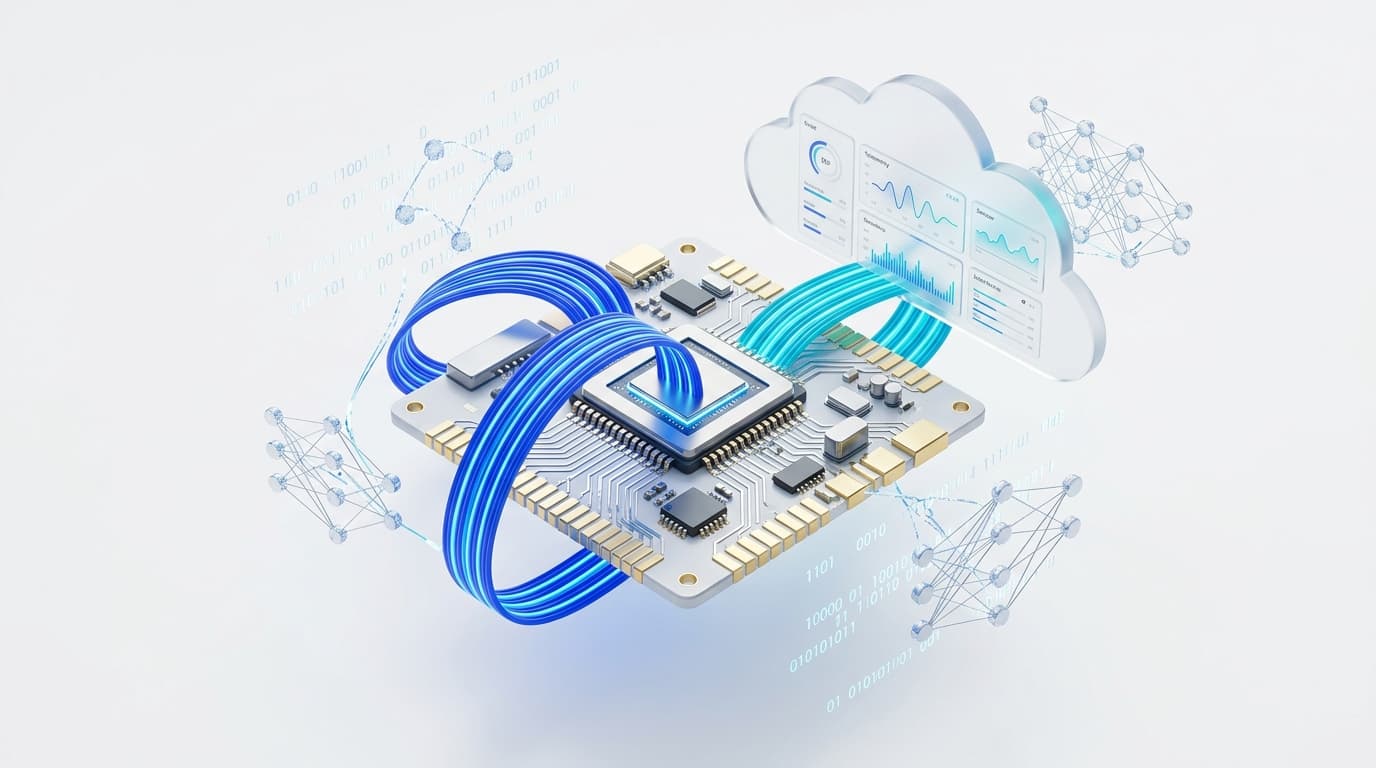
The Great Divide in Modern Engineering
For decades, the technology industry has operated within rigid specializations. Software engineers write high-level cloud code in TypeScript or Python, often disconnected from the physical silicon their instructions execute upon. Hardware engineers lay out PCBs and flash microcontrollers in C/C++, frequently struggling to integrate their sensor streams into modern responsive web dashboards or cloud authentication layers.
Meanwhile, artificial intelligence teams train complex neural networks in Jupyter notebooks without considering the edge compute constraints of an ESP32 or the deterministic validation required in high-reliability industrial automation.
At K.N.Erve Technologies Pvt. Ltd., we believe the most impactful innovations happen at the intersection of these domains. By breaking down the traditional barrier between software, AI, and hardware, cross-disciplinary engineering enables teams to build cohesive, end-to-end solutions that are faster, more resilient, and simpler to maintain.
The Cross-Disciplinary Spectrum: From Silicon to Cloud
To illustrate what cross-disciplinary engineering looks like in practice, consider how an environmental monitoring or smart robotics platform is built when all layers are designed by one synchronized team:
| 1 | [Physical Sensors / Actuators] |
| 2 | │ |
| 3 | ▼ |
| 4 | [Embedded Firmware: ESP32 / FreeRTOS] |
| 5 | │ (MQTT / TLS / LoRaWAN) |
| 6 | ▼ |
| 7 | [Cloud Ingestion Gateway & Broker] |
| 8 | │ |
| 9 | ▼ |
| 10 | [AI Reasoning & Anomaly Detection Pipeline] |
| 11 | │ |
| 12 | ▼ |
| 13 | [Real-Time Next.js Operator Dashboard & Alerts] |
1. The Physical Layer: Deterministic Firmware
At the base of the stack, real-world data originates from physical sensors: temperature, vibration, LiDAR points, current draw, or optical cameras.
- Instead of using bloated abstraction layers, we write efficient, bare-metal or FreeRTOS firmware in C and C++.
- Critical routines — such as sensor polling, hardware interrupts, and battery power profiling — are designed with deterministic execution and fault-tolerant watchdog timers.
2. The Bridge: Reliable Connectivity Protocols
Transmitting physical data to the cloud requires protocols tailored to bandwidth and power constraints:
- MQTT over TLS: Lightweight publish/subscribe messaging perfect for intermittent cellular or Wi-Fi connections.
- LoRaWAN: Long-range, ultra-low-power radio telemetry for agricultural and sprawling campus deployments.
- Local Fallback Queues: When network connections drop, edge firmware buffers data in local SPI flash memory, ensuring zero data loss during connectivity blackouts.
3. The Intelligence Layer: Stream Processing & Grounded AI
Once telemetry reaches the cloud, artificial intelligence shifts from a theoretical academic experiment into a practical operational tool:
- Streaming Anomaly Detection: Rather than waiting for a machine to overheat or a pipeline to fail, streaming ML models evaluate telemetry trends against historical baselines in real time.
- Deterministic Validation: AI insights are passed through rule-based sanity checks before triggering automated downstream actions.
4. The Human Interface: Responsive, High-Performance Web
The most sophisticated hardware and AI are useless if human operators cannot quickly understand what is happening:
- We build clean, responsive operator dashboards using Next.js, React, and Tailwind CSS.
- Real-time WebSockets update telemetry dials and status badges with sub-second latency, giving operators immediate visibility without page refreshes.
Why Cross-Disciplinary Fluency Matters for Businesses
When companies hire separate vendors for hardware development, cloud web applications, and data analytics, projects frequently suffer from severe handoff friction:
- The hardware vendor blames the cloud API for dropped packets.
- The web developer blames the hardware team for malformed byte arrays.
- The project timeline slips, integration costs multiply, and debugging becomes an exhausting game of finger-pointing.
By partnering with an engineering firm fluent across the entire spectrum, businesses achieve:
- Faster Time to Market: Prototypes transition from breadboards to cloud-connected field trials in weeks, not quarters.
- Cohesive Security: Cryptographic keys are burned directly into hardware silicon and verified through the entire cloud network chain.
- Optimized Cost & Power: Hardware specifications are sized accurately to match actual cloud workload requirements, preventing expensive over-provisioning.
Empowering Learners Through Multi-Domain Problem Solving
Cross-disciplinary capability is not just an enterprise advantage; it is the core philosophy of our Technology Education and Skill Development programs.
When students in our STEM maker labs and university workshops build a project, we do not limit them to writing Python loops in a terminal. They wire physical motor drivers, write microcontroller firmware, connect ESP32 modules to web dashboards, and integrate simple machine learning models for computer vision.
By experiencing how code directly influences physical motors, lights, and sensors, abstract computer science concepts become intuitive, tangible, and exciting. Students gain the confidence to view themselves not merely as software consumers, but as full-stack technological creators.
Conclusion: The Integrated Future
The most urgent challenges of our time — from industrial automation and smart agriculture to intelligent healthcare infrastructure — do not exist entirely in the cloud or entirely in physical hardware. They live at the junction where silicon, code, and human workflows converge.
At K.N.Erve Technologies Pvt. Ltd., mastering that junction is our daily craft.
Looking to integrate custom hardware with scalable cloud software or train your students in hands-on physical computing? Reach out to our team or explore our Engineering Services.